
Self Storage Gate Code Automation: How AI Resolves Access Issues 24/7
A contractor stands at your gate at 4 AM with a job starting in 20 minutes and a gate code that isn't working. What happens next depends entirely on whether AI is answering your phones.
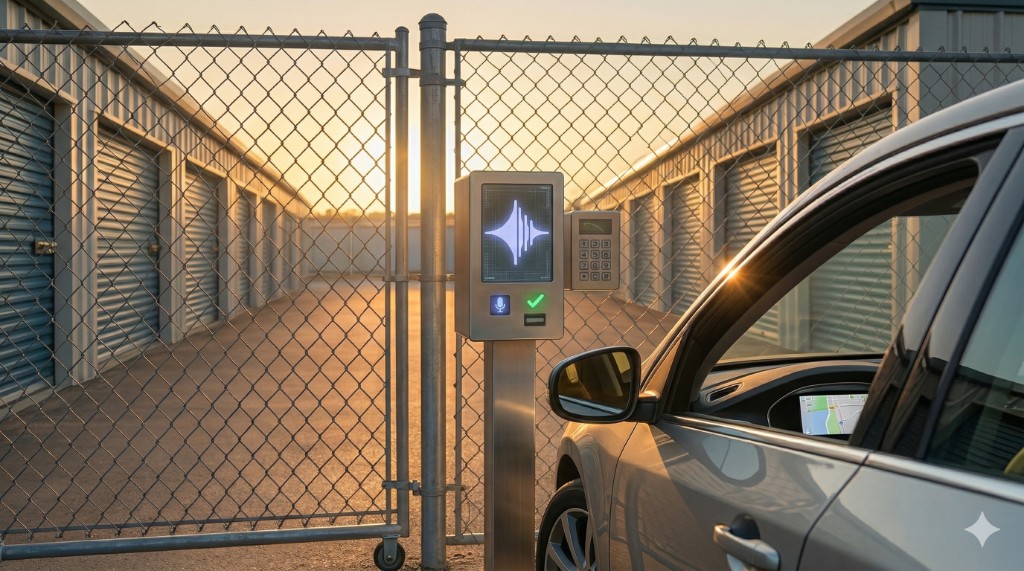
A tenant is standing at the gate of a self storage facility at 4 AM. He's a contractor. He needs to retrieve his work trailer. A job starts in 20 minutes. His gate code isn't working.
Without AI: he calls the facility number, hits voicemail, drives home without the trailer, and misses the job.
With AI: the call is answered in seconds. The agent troubleshoots the code entry, then texts a temporary access code. He's through the gate in under five minutes. No manager woken up. No job missed.
This scenario — or something close to it — plays out regularly at self storage facilities. Gate access is the most time-sensitive call type in the industry. A tenant who can't get into their unit isn't mildly inconvenienced. They're locked out of their own property, right now.
The Scale of the Problem
Gate access calls represent between 4% and 17% of all calls at self storage facilities, depending on the operator type. For RV and boat storage — where tenants access large vehicles on irregular schedules — nearly 1 in 6 calls is a gate access issue.
The urgency matters because gate access calls don't follow business hours. Across thousands of gate access calls, over a third come in when no staff is available — either during the gap between office close and gate close (typically 5 PM–10 PM), or after the facility shuts down entirely overnight.
And 5 PM is the single busiest hour for gate access calls. That's when offices close and tenants arrive after work.
The Gap Window: The Most Overlooked Coverage Problem
Most self storage facilities operate with access hours (typically 6 AM–10 PM) that extend well beyond office hours (typically 9 AM–5 PM). This creates a critical gap every evening: the gate is open, tenants are accessing the facility, but there's no one in the office to help when something goes wrong.
During this gap — gate open, office closed — AI resolves nearly 7 in 10 access calls without a transfer. When the facility is completely closed overnight, AI handles nearly 9 in 10.
The math is straightforward: the less staff is available, the more the AI takes over. This is exactly how it should work.
What Actually Causes Gate Access Calls
Based on real call data, gate access calls break into predictable categories:
Forgot gate code (~40% of calls) The most common situation. The tenant is physically at the gate and can't remember their code. The AI looks up their account and sends the gate code via a secure text link — typically resolved in under 60 seconds.
Code not working (~25% of calls) The tenant has their code but the gate isn't responding. The AI troubleshoots: Did they enter it correctly? Is their account in good standing? If there's a gate malfunction, the AI escalates. Many of these resolve without a transfer.
After-hours or 24-hour access requests (~15% of calls) A tenant needs to get in outside normal gate hours — early morning, late at night. The AI collects their information and either arranges a temporary access code or logs an urgent request for the team to process first thing.
Third-party access coordination (~10% of calls) A tenant needs to let someone else in — a tow truck, a family member, a contractor. The AI gathers the details and sends a temporary code or routes to the appropriate team.
Security and lock issues (~10%) Unexpected lock on a unit, concerns about unauthorized access. These generally need physical presence — the AI escalates and documents.
Real Scenarios
The stories from actual gate access calls show the range of situations AI handles:
A customer's storage app went down and they couldn't get in. The AI sent their gate code via text as a backup channel. Resolved in 35 seconds.
A customer needed to arrange access for a tow truck removing a fire-damaged RV per insurance instructions. The AI sent a temporary gate code valid for 7 days — a complex, emotionally charged situation handled cleanly.
A tenant called because they were trapped inside the facility and couldn't open the exit gate — they needed to get to the hospital. This is the most urgent version of a gate access call, and it happened when no staff was on site.
In each case, the AI answered immediately, worked through the situation, and resolved or escalated — without anyone waiting on hold or leaving a voicemail.
Weekend and Early-Morning Coverage
Over 400 gate access calls happen on weekends — Saturdays and Sundays when staff isn't working. Monday is the single busiest day for access calls, likely as tenants return from weekend use of their stored vehicles or equipment.
Early mornings are also significant: calls as early as 5 AM from RV owners, boat owners, and contractors accessing work equipment. This is a customer segment that operates on schedules that don't align with traditional office hours.
The Competitive Consequence
A tenant who can't get into their unit and reaches voicemail has a simple next step: they Google another storage facility. Gate access failures are one of the highest-churn triggers in self storage — not because the facility did anything wrong, but because the tenant couldn't get help in the moment they needed it.
For operators who've invested in AI-based phone coverage, this moment becomes a recovery opportunity instead of a churn event. The tenant is frustrated. The AI answers. The code is texted. The tenant gets in. The frustration dissipates before it becomes a review.
How Lumio Handles Gate Access
Lumio's gate access workflow integrates with your FMS to look up tenant accounts, retrieve gate codes, and send them via secure text links. The workflow is configurable: operators can set policies for which situations get resolved automatically, which get escalated, and how after-hours requests are handled.
The best-performing operators in terms of gate access deflection are handling over 85% of these calls without a human transfer — including the 4 AM calls, the weekend calls, and the situations that feel like emergencies.
Keep Reading
Self Storage After-Hours Answering: Your Options in 2026
Gate access calls peak after 5 PM. Here's how operators are covering the gap.
What Is an AI Self Storage Agent?
The complete guide to what an AI agent does — gate codes, payments, rentals, and more.
The Real Cost of a Self Storage Call Center
What you're paying for gate code calls that AI resolves in 30 seconds.
Want to see how Lumio handles gate access for your facilities? [Book a demo](https://www.lumiostorage.com/book-demo) — we'll walk through real call data and show you the workflow.
Ready to Transform Your Operations?
See how Lumio can help you scale your portfolio without adding headcount.
Book a Demo