
Self Storage Payment Automation: Why Teams Drown on the 5th of Every Month
Every storage operator knows what happens in the first week of the month. By the 4th and 5th, call volume runs at three times the normal rate. The pattern repeats every month — and most teams are absorbing it manually.
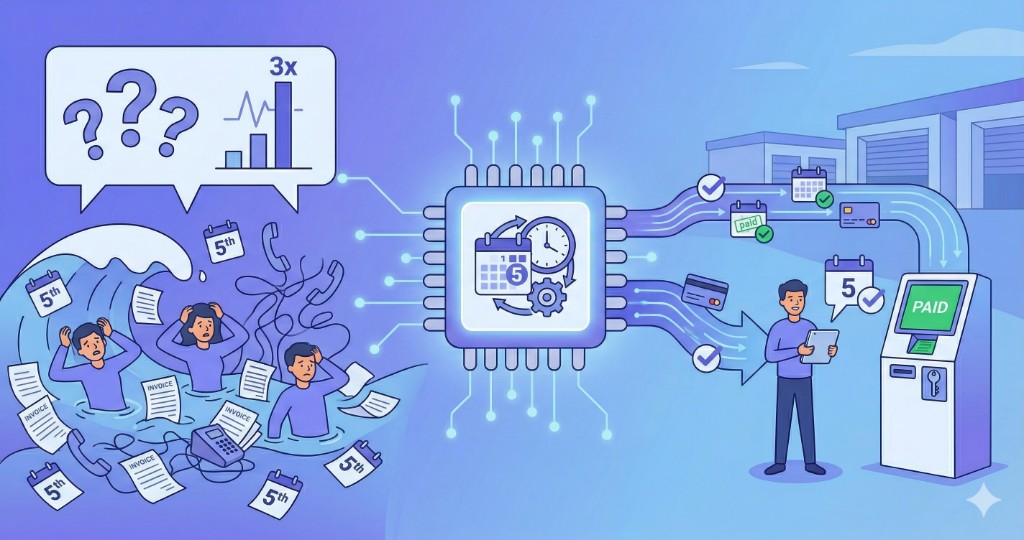
Every storage operator knows what happens in the first week of the month. The phones start ringing on the 2nd. By the 4th and 5th, call volume is running at three times the normal rate. The pattern repeats every single month, like clockwork.
It's not complaints. It's not move-out notices. It's payments.
Rent is due. Late fees kick in. Autopay fails. Tenants who haven't paid notice the charge — or don't notice and get locked out. The first-week payment surge is one of the most predictable operational challenges in self storage, and most operators handle it the same way: by overwhelming their team and hoping for the best.
The Spike Is Real — And Bigger Than You Think
Payment call volume doesn't just rise in the first week of the month. It spikes dramatically. The 4th and 5th of the month see payment call volumes roughly three times higher than the baseline.
That's three times the staff capacity needed, three times the hold times, three times the dropped calls, three times the frustrated tenants. For facilities with a single office line or a shared call center arrangement, the math doesn't work. Tenants wait. Some hang up. Some call back. Some just stop paying.
The irony is that these are your most motivated callers. They're calling because they want to pay. The friction between "I want to pay my bill" and "I can't get through" is entirely an operational problem — not a tenant motivation problem.
What Happens After the Surge
The calls that don't get through during the peak don't disappear. They turn into:
- Repeat calls — the same tenant calling back again, doubling the volume problem
- Late fees — tenants who can't get through to pay end up with fees that create billing disputes
- Lien risk — missed payments that cascade into the lien process, generating more staff work
- Churn — frustrated tenants who find a competitor with a better payment experience
The real cost of the monthly payment surge isn't just the staff time. It's the downstream effects: disputes, fees, churn, lien processing. All of it traces back to friction at the point of payment.
The Weekend Problem
The payment surge isn't limited to weekdays. Over a thousand payment calls arrive on weekends across typical multi-facility operators — Saturdays and Sundays when office staff isn't working.
For tenants trying to pay before their late fee kicks in, the weekend is their last window. If they can't get through, the fee hits, and suddenly a simple payment call turns into a billing dispute on Monday.
Voicemail is not a payment processing solution.
What AI Changes
AI-based payment handling doesn't just reduce call volume for staff — it eliminates the surge as a problem category entirely.
When every payment call gets answered immediately — at any hour, on any day, on the 5th of the month or the Sunday before — the surge becomes invisible. The calls come in. They get handled. The tenant makes their payment. The call ends.
Across operators using AI payment handling, nearly 3 in 4 payment calls are resolved without any human involvement. That includes:
- Verifying the tenant's account
- Looking up their current balance
- Processing a payment via saved card on file or new card
- Sending a secure payment link via text for tenants who prefer to pay on their own device
- Explaining charges — late fees, protection plan costs, card processing fees
- Updating payment methods after a card is lost or stolen
For calls that do need staff — complex billing disputes, past-due accounts requiring payment arrangements — the AI gathers context first, then transfers with everything documented.
The "Calls During Business Hours" Insight
Here's what most operators don't realize: 88% of payment calls come in during business hours.
This isn't an after-hours problem. It's an all-day problem. While your team is helping in-person customers, managing the facility, handling maintenance, and doing everything else required to run a storage operation, the phones are ringing with payment calls.
When AI handles payment calls, your team isn't freed from the phones at 8 PM — they're freed at 10 AM. During your busiest hours, during the week, while the office is fully staffed. The operational relief is immediate and ongoing.
The Simple Math
Take your current monthly payment call volume. Multiply it by 3 for the 4th and 5th. Estimate how many of those calls don't get through. Multiply that by your delinquency rate. You have a rough estimate of the payment delays, fees, and disputes that are preventable.
Now invert it: AI handles every one of those calls. Every tenant who wants to pay can pay — on the 5th at 9 PM, on Saturday morning, at the peak of the surge on a Tuesday afternoon. The payments come in. The late fees don't accrue. The disputes don't happen.
The monthly payment spike doesn't go away. It just stops being your team's problem.
What This Looks Like at Scale
At facilities with AI payment handling enabled, payment collection is a background process. It happens continuously, without staff involvement, around the clock. The billing team sees completed transactions and a small queue of escalated cases — disputed charges that need human judgment. Everything else is already done.
That's what moving from reactive to automated looks like for payment operations: the calls still come in, but your team never answers them.
Keep Reading
How AI Enrolls Self Storage Tenants in Autopay — On Every Payment Call
Every autopay enrollment is one fewer payment call next month, and every month after.
Self Storage Automation Isn't an After-Hours Tool. It's a Business-Hours Tool.
9 in 10 payment calls happen during business hours. AI handles the surge.
The Real Cost of a Self Storage Call Center
What you're paying your call center to handle payment calls that AI resolves automatically.
Want to see how payment automation works for facilities like yours? [Book a demo](https://www.lumiostorage.com/book-demo) — we'll walk through the payment call workflow and show you what the 5th of the month looks like with AI handling the surge.
Ready to Transform Your Operations?
See how Lumio can help you scale your portfolio without adding headcount.
Book a Demo